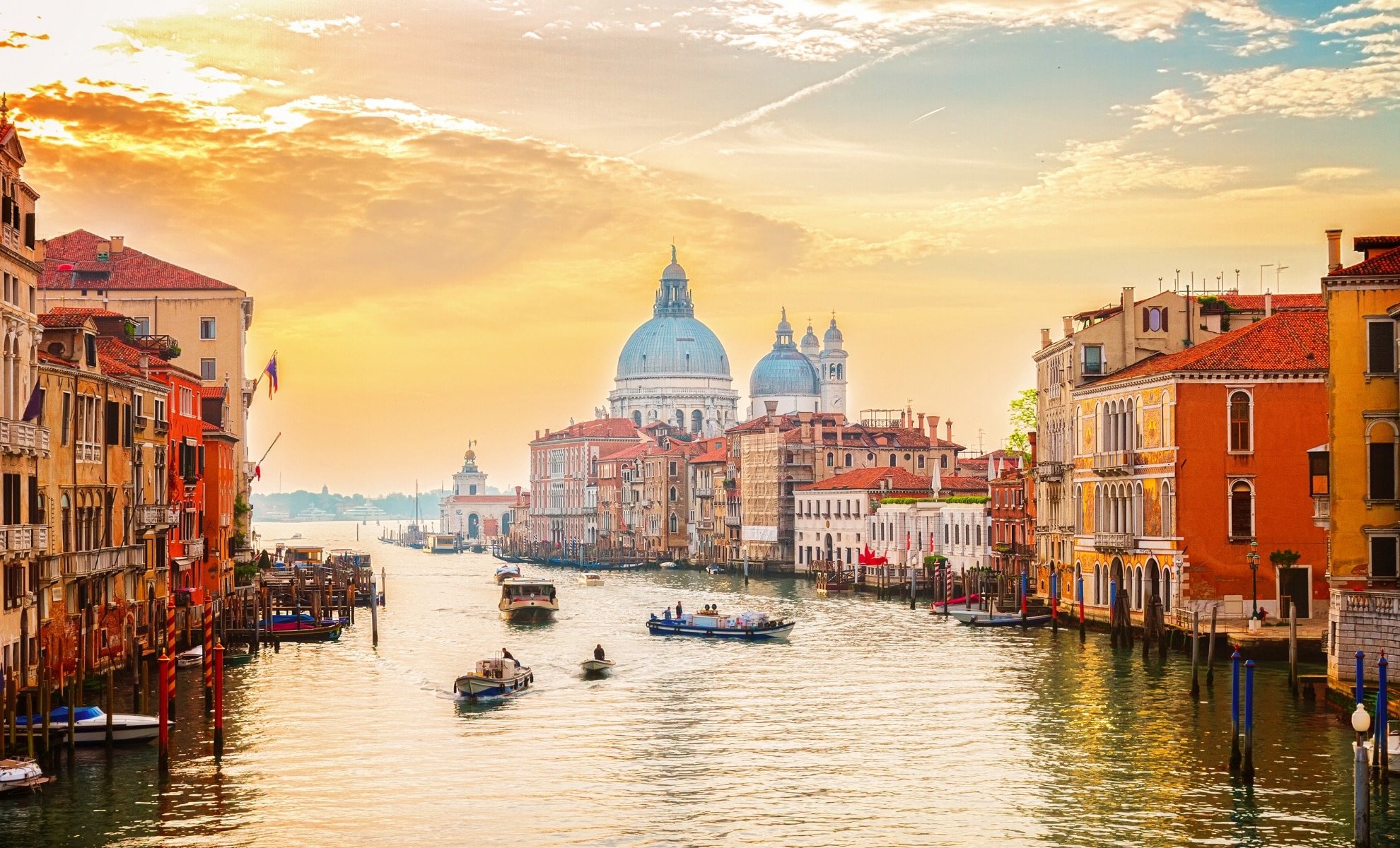
Your first 48 hours
Day 1: Landing
- ArriveBus 5 to Piazzale Roma in about 25 minutes, then vaporetto line 1 down the Grand Canal. Book a water taxi if you land late with heavy bags.
- 16:00Cross the Rialto Bridge and walk into San Polo for the Frari, where Titian’s Assumption hangs over the high altar.
- 19:00Cicchetti and a spritz at the counter of a bacaro (wine bar) near the Rialto market.
Day 2: San Marco
- 09:30St Mark’s Basilica at opening on a booked slot, then the Doge’s Palace and the Bridge of Sighs.
- 14:00Lunch in Castello, then line 2 across to San Giorgio Maggiore and its bell tower.
- 18:00Sunset on the Zattere, then dinner around Campo Santa Margherita in Dorsoduro.
Getting in and around
Marco Polo airport sits on the mainland shore of the lagoon. The quickest way in is by road. ACTV bus 5, the Aerobus, leaves every 15 minutes from outside arrivals and reaches Piazzale Roma, the bus terminal at the edge of the old city, in about 25 minutes. In 2026 it costs €10 one way, €18 return. The ATVO express coach does the same run in about 20 minutes. Beyond Piazzale Roma there are no cars: you walk or take a boat.
Alilaguna boats are slower but drop you closer to many hotels. The Orange line runs down the Grand Canal to Rialto in about 70 minutes; the Blue line goes via Murano and the Lido to San Marco in about 75. A single costs €18, a return €32, with one large bag included and €4 for each extra one. The dock is a signed walk from the terminal. A water taxi takes you to your hotel’s door, but expect a three-figure fare and agree it before you board.
If you land at Treviso, ATVO and Barzi coaches meet the flights. Allow about an hour to Venice.
In town, walk. From Santa Lucia station to St Mark’s Square takes 30 to 35 minutes on foot, longer with a suitcase over the bridges. The vaporetto (water bus) costs €9.50 for a 75-minute ticket, so a pass pays for itself from the third ride of the day: €25 for 24 hours, €35 for 48, €45 for 72 and €65 for seven days, counted from the first validation. Tap your ticket on the reader before each boarding.
Line 1 is the slow boat down the Grand Canal: 44 minutes from Piazzale Roma to San Marco. Line 2 is quicker and stops at San Giorgio Maggiore. Lines 4.1 and 4.2 reach Murano from Fondamente Nove in 9 minutes, and line 12 continues to Burano. To cross the Grand Canal between bridges, stand in a traghetto, a gondola ferry rowed by two oarsmen, for €2.
Things to book
In 2026 the Doge’s Palace costs €35 at the door and €30 online if you book at least 30 days ahead. The Basilica costs €10 and sells entry for a fixed time, through the Porta San Pietro. The Peggy Guggenheim Collection sells timed slots online until they run out. Book these three first, then leave space for the islands and an evening of cicchetti.

Doge’s Palace entry and guided tour

St Mark’s Basilica timed entry with guide

Peggy Guggenheim Collection timed entry

Murano, Burano and Torcello boat trip
Cicchetti and wine walk in Venice

Shared gondola ride in Venice
Neighbourhoods at a glance
Venice has six districts, the sestieri, plus the islands across the water.
San Marco. The square, the Basilica, the Doge’s Palace and the most expensive coffee in town. Packed from late morning to late afternoon, calm once the day visitors leave.
Dorsoduro. South of the Grand Canal: the Accademia, the Guggenheim, the Salute church and the long Zattere waterfront. Students keep Campo Santa Margherita busy in the evening.
San Polo and Santa Croce. The Rialto market, the Frari and the Scuola Grande di San Rocco. Many of the best bacari are in the lanes behind the market.
Cannaregio. From the station to the Ghetto, the most lived-in district. The Fondamenta della Misericordia and the Fondamenta degli Ormesini are where locals drink by the canal.
Castello. The largest district, east of San Marco, with the Arsenale, the Biennale gardens and Via Garibaldi, the widest street in the city. Washing lines and neighbourhood bars instead of souvenir shops.
Giudecca and the Lido. Giudecca faces the city across a wide canal, with the best views back at the Zattere. The Lido is a long sandbar with a real beach, 15 minutes by boat from San Zaccaria.
What to eat
Cicchetti. Small bites eaten standing at a bacaro counter, usually with an ombra, a small glass of wine. Order two or three, pay, move on. Baccalà mantecato (salt cod whipped with oil, on bread or polenta) is the classic.
Sarde in saor. Fried sardines left to marinate in sweet-sour onions with pine nuts and raisins. A sailors’ dish that keeps for days.
Seppie al nero. Cuttlefish stewed in its own ink, served black with white polenta. You also find the ink in risotto.
Fegato alla veneziana. Calf’s liver with slow-cooked onions. Better than it sounds, and on most trattoria menus.
Bigoli in salsa. Thick wholewheat spaghetti with an onion and anchovy sauce, once a dish for meatless days, now eaten all year.
Spritz. White wine or prosecco, soda and a bitter. Ask for Select, the bitter created in Venice, rather than Aperol.
The fish market at the Rialto works Tuesday to Saturday mornings; there is none on Sunday or Monday, and fish on a Monday menu was not landed that day.
Day trips from Venice
Padua
Verona
Vicenza
The Prosecco hills
Where to stay
Sleep in the old city if you can: the evenings and early mornings, when the day visitors have gone, are the reason to stay. Mestre, on the mainland, is cheaper and 10 minutes by train from Santa Lucia, but you lose those hours.
San Marco
Dorsoduro
Cannaregio
Castello
When to go
- JanQuiet
- FebBusy
- MarGood
- AprBest
- MayBusy
- JunBusy
- JulBusy
- AugBusy
- SepGood
- OctBest
- NovGood
- DecQuiet

The best windows are late March to April and late September to early November: mild days, and no day-tripper fee outside the charged days. July and August are hot and humid, with average highs around 27 °C. November is the wettest month and the peak of acqua alta, the high tides that flood the lowest squares for an hour or two; the MOSE barriers rise when a tide above 110 cm is forecast. Carnival (23 January to 9 February in 2027) fills the city, as do the Redentore fireworks on the Saturday night before the third Sunday of July and the Regata Storica on the first Sunday of September.
Money, safety and etiquette
The access fee. On set days, day visitors pay to enter the old city. In 2026 it applied on 60 days between 3 April and 26 July, from 08:30 to 16:00: €5 if paid at least four days ahead, €10 after that. For 2027, the calendar approved by the city in October 2026 has 72 charged days from 26 March to 15 August, 08:30 to 16:30; the price and the exemptions were not set in November 2026. Guests staying overnight anywhere in the municipality, children under 14 and residents of the Veneto are exempt, but overnight guests should still register on the official portal for a free QR code. Fines run from €50 to €300.
Tourist tax. Hotels charge it per person per night on top of the room: from €0.10 to €5 depending on the category, for the first five nights only.
Paying. Cards are taken almost everywhere. Restaurants add a cover charge (coperto) per person, printed on the menu; tipping beyond that is optional. Gondolas charge per boat, not per person: €90 for 30 minutes by day and €110 from 19:00, for up to five people.
Safety. Venice is safe at night. Pickpockets work the Rialto Bridge, the line 1 and 2 boats and the Piazza. Watch your feet on wet stone steps by the water.
Rules. Cover shoulders and knees in churches. No swimming in the canals, no cycling in the old city, and no picnics on bridges or the steps of monuments.
- The Basilica at 09:30. The gold mosaics before the groups arrive, on a €10 timed ticket.
- Line 1 at dusk. The Grand Canal from a seat at the front costs the price of a vaporetto ticket.
- A night in the old city. After 18:00 the lanes empty and Venice belongs to the people who live there.
- Dinner on the main route between Rialto and San Marco. Walk ten minutes into Castello or Cannaregio.
- A gondola from the Bacino at midday. Board from a quieter station in Dorsoduro or Cannaregio, or take a €2 traghetto.
- Murano glass “factory tours” sold on the street. They end in a showroom. Take line 4.1 and walk in yourself.

