Yes, €1,000 is enough for 30 days in Thailand in 2026, as long as you sleep in dorms, eat street food and travel by train and bus: allow about €31 a day on the ground. Your flight comes on top. Since 15 September 2026, French citizens can enter without a visa for up to 30 days; check the rule for your own passport before you book.
Thailand is still one of the most affordable destinations for backpackers, with a good balance between adventure and a budget you can control. With careful planning, you can travel the country for 30 days on less than €1,000 on the ground, including accommodation, food, domestic transport and activities.
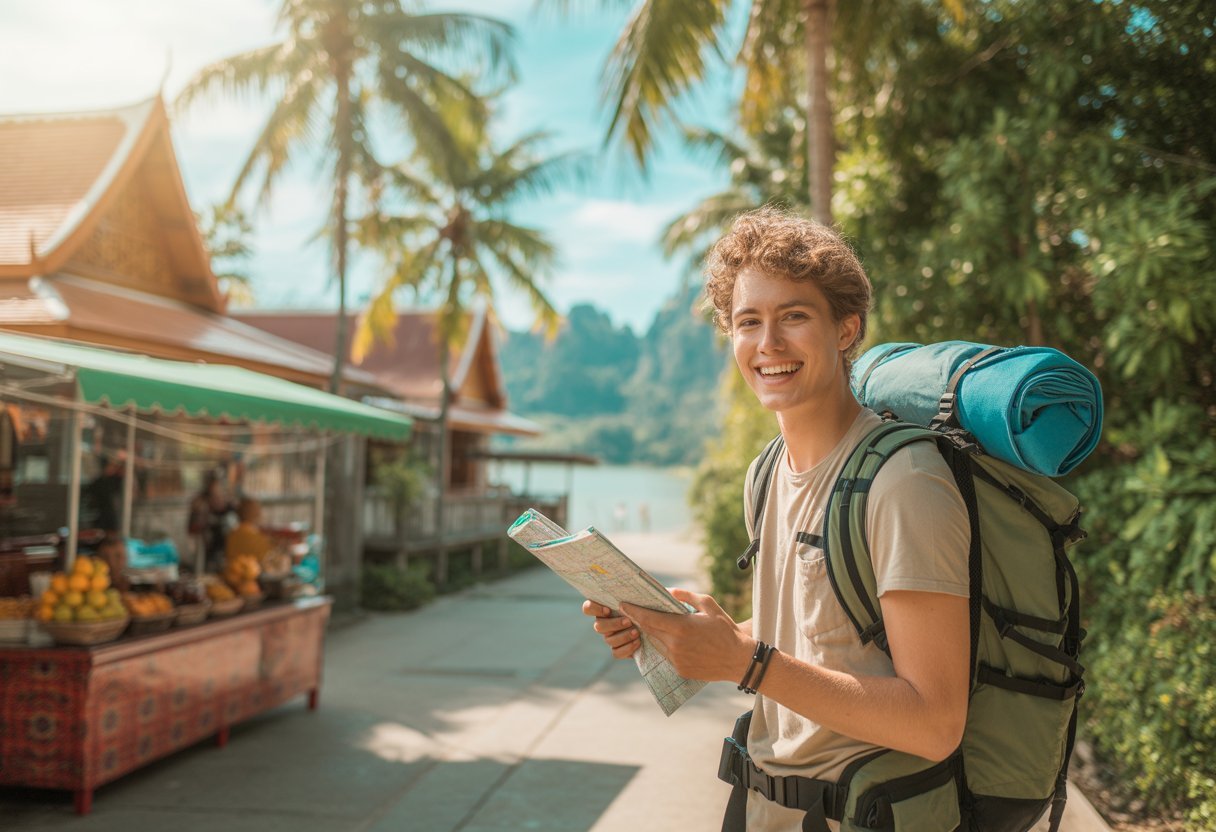
Key points
- About €31 a day (1,200 baht) covers a full backpacker trip on the ground, flights not included
- The best route combines Bangkok, the north around Chiang Mai and the southern islands
- You save most on dorm beds, street food, trains and buses
- Since 15 September 2026, French citizens get 30 days without a visa, and the online arrival card (TDAC) is compulsory
Planning a trip to Thailand on a small budget
Golden temples in Bangkok, white-sand beaches in the south, treks in the northern mountains: Thailand offers a lot of variety for little money. In 2026, a dorm bed usually costs 200 to 500 baht a night (€5 to €13), a street-food dish about 50 to 100 baht (€1.50 to €2.50), and local transport is still very cheap (this guide uses a rate of about 38 baht to €1).
The country suits backpacking well. Hostels, buses, night trains and boats to the islands form a well-worn circuit, and locals are used to travellers. Many backpackers take their first steps in Asia here, for the easy travel and the people they meet.
Preparing your trip to Thailand well can save you several hundred euros. Three steps matter: picking the right season, sorting out the paperwork and buying your flight at the right time. That flight is not part of the €1,000, so budget for it separately.
Choosing the best time to go
The rainy season (May to October) has the lowest prices. Accommodation then costs far less than in the high season, from November to March, especially on the islands.
Avoid December and January, and July and August: flights from Europe are at their most expensive of the year.
November is the best compromise: the dry season is starting, and prices have not yet reached December levels. April works too, but it is the hottest month, and prices rise around Songkran, the Thai New Year, from 13 to 15 April, celebrated with water pistols across the country.
The two coasts have different monsoons. On the Andaman Sea side (Phuket, Krabi, Koh Phi Phi), it rains from May to October; in the Gulf of Thailand (Koh Samui, Koh Tao), mostly from October to December.
If you plan to carry on to Laos, aim for October to March. For land borders, read official travel advice first: in 2026, the French foreign ministry advises against all travel within 50 km of the Cambodian border.
The monsoon does not mean constant rain. Showers often last one to two hours, in the late afternoon, and leave the rest of the day dry.
Essential documents and paperwork before you leave
Your passport must be valid for at least 6 months after your return date. Check it three months before you leave, so you do not have to pay for an urgent renewal.
Since 15 September 2026, French citizens get a visa exemption of up to 30 days, for tourism only; it was 60 days until then. The French foreign ministry adds that only two visa-free entries are allowed per calendar year. The rules depend on your nationality, so check those for your passport.
In the three days before you arrive, fill in the digital arrival card (TDAC) on the official immigration website, tdac.immigration.go.th. It has been compulsory since 1 May 2025 and is free: beware of sites that charge for it. Also keep proof of sufficient funds to hand, as immigration may ask for it.
Take out travel insurance that covers your whole stay, with medical cover of at least €100,000 and repatriation. Seeing a doctor is affordable in Thailand, but a stay in a private hospital or a repatriation costs a great deal.
| Document | Requirement | Good to know |
|---|---|---|
| Passport | Valid 6 months after your return | Check it three months before you leave |
| TDAC arrival card | In the 3 days before arrival | Free, at tdac.immigration.go.th |
| Travel insurance | Whole length of stay | Medical costs and repatriation |
| Vaccinations | None compulsory from Europe | Hepatitis A recommended |
On health, France’s Institut Pasteur recommends the hepatitis A vaccine. You need no malaria tablets for a classic route: Bangkok, Chiang Mai, Phuket and Koh Samui have no reported risk.
Copy all your important documents, and keep a photo of them on your phone. Pack the originals and the copies in separate bags.
Tips for finding cheap flights
Compare prices on several flight comparison sites, such as Skyscanner, Momondo or Google Flights, with flexible dates. Our Google Flights tricks cover the useful filters and price alerts.
Look at flights with one stop, for example via Istanbul, Doha or Dubai: they are often cheaper than direct flights.
Book your tickets 3 to 4 months ahead for the best fares. Prices rise sharply in the last six weeks.
Midweek departures, on a Tuesday or Wednesday, are usually cheaper than weekend ones.
Compare departures from other airports within reach too, even across a border: the saving can cover the trip to the airport.
For domestic flights, watch for sales from low-cost airlines such as Thai AirAsia or Nok Air.
Packing your backpack well
Choose a backpack of about 40 litres: that is roughly the size that fits most airlines’ cabin limits. A 50- to 60-litre pack goes in the hold, with a surcharge on low-cost flights.
Pack light technical clothing that dries quickly. Cotton stays damp in a tropical climate.
Take only the essentials. You will find everything locally, cheaply, in markets and convenience stores.
What to pack:
- 3 or 4 breathable T-shirts
- 2 pairs of light shorts or trousers, one of them covering the knees for temples
- Sandals and walking shoes
- A basic first-aid kit
- SPF 50+ sunscreen
- Mosquito repellent
Leave 20% of the space free for shopping. Thai handicrafts make good, cheap souvenirs.
Leave expensive electronics at home. A waterproof smartphone is enough for your travel photos.
A detailed budget for 30 days in Thailand
A budget of €1,000 for 30 days in Thailand works on the ground, flights not included. Daily spending runs at about €25 to €35 as a backpacker, if you stick to dorms and street food.
Cost of living: accommodation, meals and activities
Accommodation is your biggest expense. Allow about €7 to €13 a night in a dorm, or about €300 for the month.
Food is one of the country’s great strengths. A street dish of Thai food costs about 50 to 100 baht (€1.50 to €2.50) in 2026.
A pad thai in a local canteen costs about €2. Allow €6 to €10 a day for food, or about €240 over 30 days.
Activities stay affordable. Many temples are free, and the major sites cost 100 to 300 baht; the most expensive, the Grand Palace in Bangkok, costs 500 baht (€13).
| Item | Daily cost | Monthly cost |
|---|---|---|
| Accommodation | €10 | €300 |
| Food | €8 | €240 |
| Activities | €7 | €210 |
National parks charge foreigners 100 to 500 baht to enter (€3 to €13). A traditional massage costs about €7 to €10 an hour in 2026.
Keeping transport costs down
Transport in Thailand can take 20% of your budget if you move around a lot. The Bangkok to Chiang Mai night train leaves from Krung Thep Aphiwat station and takes 12 to 13 hours; an air-conditioned second-class sleeper costs about 700 to 1,040 baht (€18 to €27), depending on the train and on the berth, upper or lower.
Long-distance buses are often cheaper. Bangkok to Phuket is a night bus from Bangkok’s Southern Bus Terminal, in about 13 hours.
In town, take songthaews (shared pick-up trucks): 30 baht (€0.80) per person in Chiang Mai’s old city. The Grab and Bolt apps show the fare before the ride.
Low-cost domestic flights often cost €30 to €50 between big cities, booked ahead and without hold luggage.
Allow €150 to €200 for all your travel over 30 days. Stick to buses and trains to save money.
Things to do without breaking the bank
Free neighbourhood temples are everywhere. The big sites in Bangkok charge for entry: Wat Pho, home of the Reclining Buddha, costs 300 baht (€8) in 2026.
Beaches are free. Rent a mask and snorkel for a few euros a day rather than paying for a snorkelling boat trip, which costs far more.
At the Damnoen Saduak floating market, entry is free, but the boat ride costs extra and is up for negotiation. Cookery classes start at about €25 at Chiang Mai’s schools.
Hiking in the national parks is excellent value. Doi Inthanon National Park, near Chiang Mai, costs 300 baht (€8) to enter, plus 100 baht for the two royal pagodas.
Night markets, such as the Sunday market on Ratchadamnoen Road in Chiang Mai, are free and lively. Ask at local tourist offices about temple fairs and events.
Total estimate and managing your daily budget
Your total budget breaks down like this: €300 for accommodation, €240 for food, €180 for transport and €210 for activities, or €930 over 30 days, flights not included.
Keep €70 in reserve for the unexpected and for bank charges. In 2026, Thai cash machines charge about 220 to 250 baht (€6 to €7) per withdrawal with a foreign card, sometimes more, on top of your own bank’s fees. Take out large sums at a time, and when the screen offers to charge you in your home currency, say no: choose to be charged in baht, at your bank’s rate.
Note your spending every evening in a budgeting app or a spreadsheet. Set yourself a ceiling of about €31 (1,200 baht) a day.
Bargain politely in markets. On Khao San Road itself, prices for meals and souvenirs are inflated: the streets around it are cheaper.
Eat where Thais eat. A restaurant that shows its prices only in English often charges more than the going rate.
Suggested backpacker route: north, south and islands
This 30-day route starts in Bangkok, heads up to the north, then down to the beaches of the south. You will alternate temples, mountains and islands while sticking to a tight budget.
Exploring Bangkok and its temples
Bangkok is your point of entry and the best place to discover Thai culture. Allow 4 days to explore the city without overspending.
Khao San Road is still the backpacker district. Dorms there cost about €5 to €8 a night, and the surrounding streets are full of canteens where a pad thai costs about €2.
The Grand Palace and Wat Pho are worth a full day. There is no combined ticket: allow 500 baht for the Grand Palace (open 08:30 to 16:30, tickets sold until 15:30) and 300 baht for Wat Pho, or about €21 for both. Wat Pho houses the 46-metre Reclining Buddha. Shoulders and knees must be covered.
Cross the river by ferry from Tha Tien pier, for a few baht, to Wat Arun. Entry costs 200 baht (about €5) in 2026. The temple looks its best late in the day, when the sun goes down over the Chao Phraya; it closes at about 18:00.
The Damnoen Saduak floating market, about 100 km south-west of Bangkok, is reached by bus from the Southern Bus Terminal. Leave early in the morning to beat the crowds and to haggle for tropical fruit.
Discovering northern Thailand: Chiang Mai, Pai and Chiang Rai
Northern Thailand offers mountain scenery and a calmer pace than Bangkok. Your daily budget drops to about €15 to €20 there, excluding transport.
Chiang Mai deserves 5 days. The night train from Bangkok arrives in the morning, after 12 to 13 hours. Hostels in the centre have beds for about €4 to €6. You can also make the trip by day and stop at Ayutthaya on the way.
The Doi Suthep temple looks down on the city from 1,073 metres. The red songthaews that go up leave from Chang Phuak Gate, for about 80 baht per person. Foreigners pay to enter the temple, and the view over the city rewards the effort.
Pai draws backpackers with its laid-back atmosphere. The minibus from Chiang Mai takes about 3 hours on a very winding mountain road: take a travel-sickness tablet. Simple bungalows cost about 200 to 500 baht a night. The hot springs, on the other hand, charge for entry: 300 baht at Tha Pai, run by the national park, and 200 baht at Sai Ngam.
Chiang Rai takes 2 or 3 days. The Greenbus from Chiang Mai costs about 200 to 300 baht and takes about 3 hours 30 minutes. The White Temple (Wat Rong Khun) costs foreigners 100 baht; a local bus takes you there from the bus station in 30 minutes, for about 20 baht. The Blue Temple (Wat Rong Suea Ten) completes the visit.
Heading south: beaches and islands
To reach southern Thailand, the quickest option is the Bangkok to Phuket flight, at around €30 to €50 if you book early. The night bus is cheaper but slower. Another option is the night train to Surat Thani (about 10 hours 30 minutes), then a minibus to Krabi (3 hours) or Phuket (4 hours 30 minutes).
Phuket works as a base for 3 days. Skip Patong, the most touristy and noisiest beach, and go for quieter Kata Beach. Hostels cost about €8 to €12 a night.
Krabi and its surroundings deserve 5 days. Railay Beach is reached by longtail boat from Ao Nang: about 100 baht per person for a 10-minute crossing, and the boat leaves when it is full (8 passengers). Depending on the tide, you may board in knee-deep water. These beaches are lined with limestone cliffs.
Khao Sok National Park is a change of scene: jungle, cliffs and Cheow Lan Lake. Entry costs 200 baht for the village area, and 300 baht more for the lake. Nights in floating bungalows are mostly sold as one- or two-day trips, with boat and meals: it is one of the biggest costs of the trip, so compare agencies.
Koh Phi Phi is still very busy. Maya Bay, the beach from the film The Beach, can now be visited only under restrictions, and closes every year from 1 August to 30 September to let nature recover. National park entry costs 400 baht (€10.50), often included in the price of tours. Allow 3 days and €10 to €15 a night for accommodation.
Koh Tao, in the Gulf of Thailand, suits lazy beach days as well as diving. The first diving level (Open Water) costs about 12,000 baht, a little over €300, for two and a half days of training in 2026: it does not fit in the €1,000 budget, so plan for it separately. From Chumphon station, the Lomprayah bus and catamaran ticket costs about 900 baht.
Tips for visiting UNESCO sites without overspending
Thailand’s UNESCO sites will not strain your budget. Ayutthaya, the former capital of Siam, is the ideal day trip from Bangkok.
The third-class train from Hua Lamphong station costs 15 to 20 baht (€0.50) and takes 1 hour 30 minutes to 2 hours. Once there, a bicycle costs about 40 to 50 baht a day to rent, and the ruins are easy to see by bike. The main temples cost 80 baht each; a 300-baht ticket covers seven sites for seven days.
Download free audio guides or buy second-hand guidebooks on Khao San Road. Check opening times before you go: many temples close in the late afternoon, but Wat Phra Si Sanphet in Ayutthaya stays open until 19:00.
Skip expensive organised tours. Public transport takes you everywhere for a fraction of the price. In Bangkok, the orange-flag boat costs 19 baht a trip on the Chao Phraya, on weekdays.
Negotiate longtail boat prices as a group, and share costs with backpackers you meet at the hostel. This works especially well on the islands.
Practical tips for a real backpacker trip under €1,000
Staying under €1,000 means getting four things right: eating on the street, sleeping in hostels or guesthouses, using public transport and travelling respectfully.
Eating local and discovering street food
Thai food is your best ally for saving money. A street-food meal costs about 50 to 100 baht (€1.50 to €2.50) in 2026.
Choose the stalls where Thais eat. You will find pad thai, som tam (green papaya salad) or khao pad (fried rice) for very little.
Night markets offer a wide choice of dishes for under 100 baht. Tourist restaurants often charge two to three times as much.
| Type of meal | Average price (2026) | Where to go |
|---|---|---|
| Street food | 50-100 baht | Local markets, street stalls |
| Local restaurants | 100-150 baht | Residential areas |
| Tourist restaurants | 250-400 baht | Best avoided |
Buy whole fruit from street vendors: it is much cheaper than the cut portions sold in tourist areas.
Choosing cheap, authentic places to stay
Hostel dorms cost about 200 to 500 baht a night (€5 to €13). Book the first night online, then negotiate on the spot if you stay on.
Family-run guesthouses often have simple private rooms from about 400 to 600 baht. Some include breakfast.
Compare the prices on Hostelworld, on Booking.com and at reception: booking direct is sometimes cheaper.
Ask for a discount: for a stay of more than 3 nights, ask for 10 to 20% off. Owners often agree, especially in low season.
In Bangkok, the lanes around Khao San Road, such as Soi Rambuttri, are still the cheapest; Thonburi, across the river, is calmer and less touristy.
Getting around for less: local buses, trains and scooters
Transport in Thailand is cheap if you avoid tourist shuttles. Local buses cost about 20 to 150 baht depending on distance.
Take night trains in second-class sleepers: lying down while you travel saves you a night’s accommodation.
For trips around town, use the Bolt or Grab apps rather than taxis hailed in the street. Prices are shown in advance and are often lower.
Scooter hire: about 200 to 300 baht a day, less by the week. You need a valid motorbike licence and an international driving permit: without them, your travel insurance may not cover you in an accident. Helmets are compulsory, and Thailand is among the countries with the most deaths on two wheels.
Songthaews cost about 30 to 40 baht in town. Ask the price before you get in to avoid nasty surprises.
Respecting the culture and travelling responsibly
Learn a few words of Thai. “Sawadee” (hello) and “kob khun” (thank you), followed by “khrap” if you are a man or “kha” if you are a woman, make conversations and bargaining easier.
Dress properly in temples: trousers or a skirt that covers the knees, and a top that covers the shoulders. If you need one, you can rent or buy a sarong on site for a few dozen baht.
Respect local customs when you visit floating markets: don’t touch the produce without permission, and bargain politely.
Tipping: 20 to 50 baht is enough in local restaurants. Guides expect 100 to 200 baht a day.
Avoid activities that exploit animals, such as elephant rides. Choose sanctuaries that do not allow riding.
Some local rules come as a surprise: read our guide to Thailand’s strange laws and rules before you go. The most expensive one to ignore concerns e-cigarettes: owning or using one is banned, even for personal use, and tourists face a fine, confiscation and detention.
Questions
Do you need a visa for Thailand in 2026?
Not on a French passport, for a tourist stay of up to 30 days: that is the exemption French citizens have had since 15 September 2026. Other nationalities should check their own rules. You do have to fill in the digital arrival card (TDAC) online in the three days before you arrive.
How much should you budget per day in Thailand?
About €30 a day as a backpacker, with dorms, street food, trains and buses. The north is cheaper, around €15 to €20 excluding transport; the southern islands cost more.
Is €1,000 enough for a month in Thailand, flights included?
No. €1,000 covers a month on the ground, but not the flight there, nor a diving course on Koh Tao, which costs about 12,000 baht on its own.
How do you withdraw cash in Thailand without high fees?
Make few withdrawals, but large ones: each withdrawal with a foreign card costs about 220 to 250 baht in local fees in 2026. Always refuse the conversion into your home currency that the machine offers.


