The most beautiful villages in Switzerland are in Ticino (Morcote, Ascona), the Bernese Oberland (Lauterbrunnen, Gimmelwald) and Graubünden (Soglio, Guarda), and as far as the foot of the Matterhorn, in Zermatt. You can reach all of them by train, PostBus or cable car. Here are 11 villages, each with its canton, how to get there from the nearest big town and what to see.
Between its mountains and lakes, Switzerland has kept villages where time seems to have stood still. From the patrician houses of Ticino to the chalets of the Oberland and the painted façades of eastern Switzerland, each one has a story. And almost everywhere, you arrive without a car: trains, PostBuses and boats reach right up to the mountain hamlets.
Morcote: the pearl of Lake Lugano (Ticino)
On the shore of Lake Lugano, which Italian speakers call the Ceresio, Morcote is half an hour from Lugano. This village of about 680 people, once a quiet fishing harbour, lines the water with arcades, some of them medieval, and noble houses from the 16th to the 18th centuries, such as the Palazzo Paleari, built in 1483. Since 2017 it has been a member of the association The Most Beautiful Villages of Switzerland.

Wander up its cobbled lanes to the church of Santa Maria del Sasso, rebuilt in 1462 and given a monumental stairway in the 18th century: its frescoes date from the 16th and 17th centuries, and its forecourt looks out over the lake and the Italian Prealps. Lower down, the Parco Scherrer, opened to the public in 1965 on the former estate of a textile merchant from St. Gallen, mixes subtropical plants with small-scale replicas of Mediterranean and exotic temples. With its houses stacked above the water, Morcote recalls the villages of the Amalfi Coast.
Getting there: from Lugano, allow ≈30 min, by train to Melide then bus (line 431), or come by boat, and the village appears from the lake. Lugano is ≈1 h 55 from Zurich by direct train.
Lauterbrunnen: the valley of waterfalls (Bern)
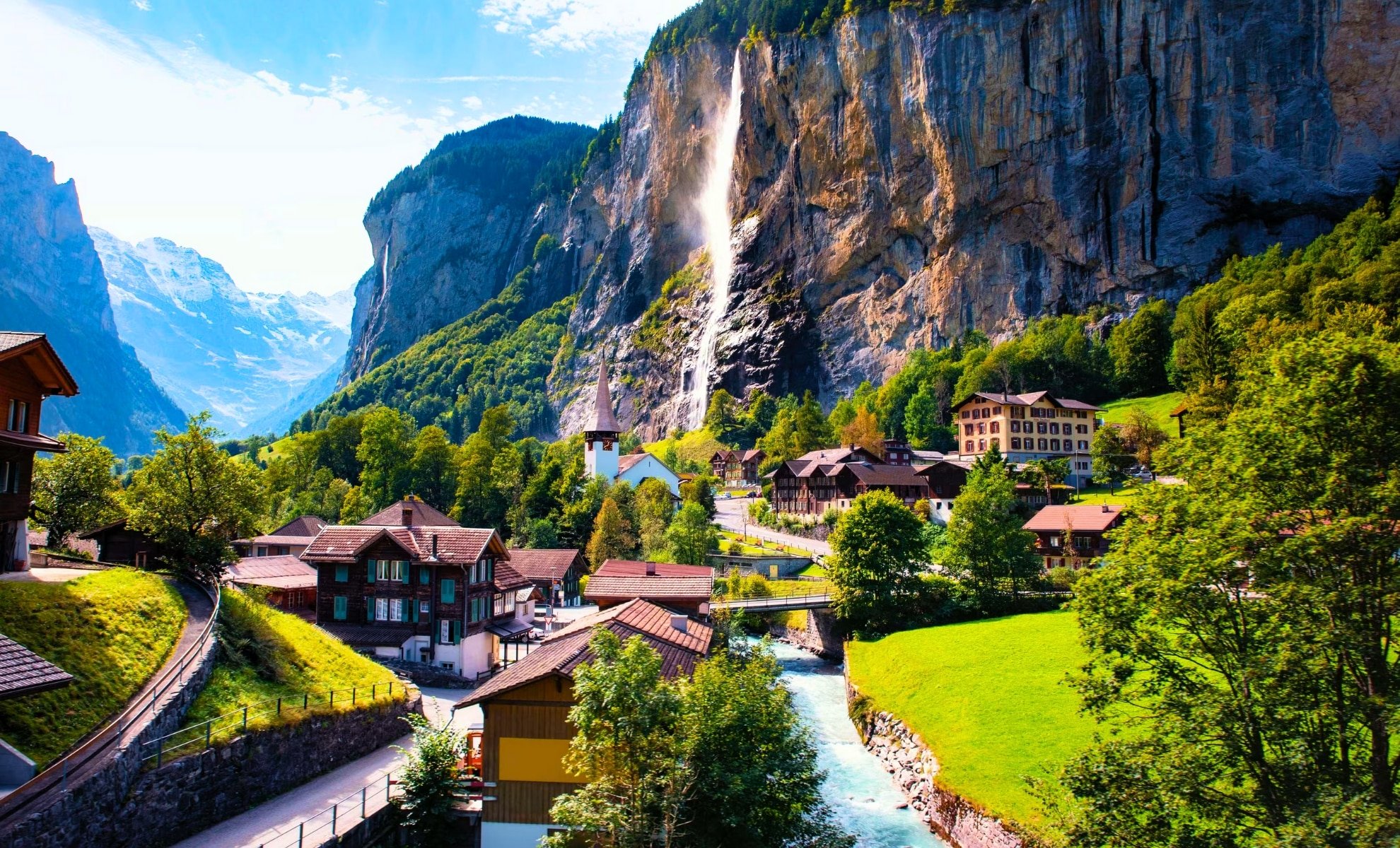
At the bottom of a U-shaped glacial valley, rarely more than a kilometre wide, Lauterbrunnen is hemmed in by rock walls with dozens of waterfalls pouring down them, below the Bernese Alps. The most famous, the Staubbach, is visible from the main street: at 297 m, it is the highest free-falling waterfall in Switzerland. The valley was the model for Tolkien’s sketches of Rivendell, the elven valley in The Lord of the Rings.

The village itself is one street of hotels and shops: the setting does all the work. On the road to Stechelberg, don’t miss the Trümmelbach Falls, ten glacier waterfalls thundering inside the mountain, reached by a lift cut into the rock. They are open from early April to early November, 09:00 to 17:00 (08:30 to 18:00 in July and August), and closed to children under 4 and to dogs. Hiking in summer, skiing in winter: the best walk climbs to Wengen and on to Kleine Scheidegg, facing the Eiger, the Mönch and the Jungfrau. For the view from above, the Schilthorn cable car leaves from Stechelberg, at the end of the valley.
Getting there: Lauterbrunnen is ≈20 min by train from Interlaken Ost and ≈1 h 20 from Bern. In summer, arrive early in the morning or stay the night: during the day, one tour group follows another.
Ascona: Switzerland’s Mediterranean side (Ticino)
Nicknamed the “pearl of Lake Maggiore”, Ascona stretches along the shore at 196 m above sea level, and the lake’s banks are the lowest point in Switzerland. Italy is close, and it shows: colourful walls, cobbled streets and Italian-style architecture.

Above the town, Monte Verità was home in the late 19th century to a community that preached vegetarianism and a life close to nature, then to thinkers such as Hermann Hesse and Carl Gustav Jung; a foundation set up in 1989, linked to ETH Zurich, the Swiss Federal Institute of Technology, now looks after it. In town, see the church of Santi Pietro e Paolo, with its frescoed choir, the Collegio Papio, built in 1584, whose courtyard is considered one of the finest Renaissance courtyards in Switzerland, and the municipal museum of modern art. Finish on the main square, by the lake. The JazzAscona festival held here is devoted to New Orleans jazz.
Getting there: Ascona is ≈7 min by bus (line 1) from Locarno station, which is ≈2 h 10 from Zurich by train, with a change at Bellinzona.
Gimmelwald: peace and quiet in the Alps (Bern)
Clinging to the slope at 1,364 m above the Lauterbrunnen valley, in the Bernese Oberland, Gimmelwald is a hamlet of about a hundred people with no road: you go up by cable car. As you walk its sloping lanes between wooden chalets, the Jungfrau and the Gspaltenhorn face you, and the valley’s waterfalls lie below your feet.

Stop at the Hotel Pension Gimmelwald, a house more than 150 years old, to try its Schwarz Mönch: this black beer, brewed in the village until 2017, was named the world’s best Schwarzbier (black lager) from 2018 to 2020, according to the house. A small cable car and a footpath link Gimmelwald with Mürren, the next village, higher up and livelier.
Getting there: Gimmelwald is part of the municipality of Lauterbrunnen. From Lauterbrunnen station, take bus 141 to Stechelberg, then the Schilthorn cable car: ≈35 min in all.
Soglio: the balcony of the Val Bregaglia (Graubünden)
Perched at 1,090 m above the Val Bregaglia, near the Italian border, Soglio is a hamlet of grey stone patrician houses, part of the municipality of Bregaglia since 2010. The de Salis family left several palaces here: the best known, built in 1630 and enlarged in 1701, is now the Hotel Palazzo Salis. The painter Giovanni Segantini stayed in the village, as did other artists.
Around the village lies the largest cultivated chestnut forest in Europe. A path runs down through the chestnut trees to Castasegna, the border village at the bottom of the valley: in October, the ground is covered in spiky husks.
Getting there: from St. Moritz, a PostBus runs down to Promontogno, where a second bus climbs to the village: ≈1 h 20 in all. From Chiavenna, on the Italian side, allow ≈35 min. Buses are infrequent: note the time of the last one before you set off on a walk.
Guarda: the village of sgraffito (Graubünden)
At 1,653 m, in the Lower Engadine, Guarda lines up thick-walled Engadine houses, almost all decorated with sgraffito, patterns scratched into the plaster that are typical of the region. This heritage won it the Wakker Prize in 1975, which rewards municipalities that look after their architecture. It is also the setting of A Bell for Ursli, the children’s book by Selina Chönz illustrated by Alois Carigiet. Part of the municipality of Scuol since 2015, the village has no shopping street: you come for the architecture and the calm.
Getting there: Guarda is on the Rhaetian Railway line that runs down the Engadine to Scuol, ≈2 h 25 from Zurich, with a change at Landquart. The station is 200 m below the village: walk up or take the PostBus (≈8 min). Ardez, another Engadine village, is only 4 min away by train.
Gruyères: castle, Giger and cheese (Fribourg)
Gruyères is one cobbled street climbing to a medieval castle, between old houses and fountains, with views of the Prealps. The little walled town, at about 800 m, is very busy at weekends: come on a weekday, or early in the morning.
Three visits justify the detour. The castle, now a museum, covers eight centuries of architecture, history and culture. The HR Giger Museum, in the Château St-Germain, shows the work of the Swiss artist who designed the creature in Alien: the contrast with the medieval town is striking. Finally, La Maison du Gruyère shows how the cheese is made.
Getting there: trains stop at Gruyères station, below the town, on the Palézieux–Bulle–Montbovon line: ≈1 h 20 from Bern (change at Bulle), ≈1 h 30 from Lausanne (change at Palézieux). From the station, walk up or take the bus to the town (≈3 min).
Appenzell: folklore that isn’t for show (Appenzell Innerrhoden)
The capital of the canton of Appenzell Innerrhoden, Appenzell lines its main street, the Hauptgasse, with gabled houses and painted façades. Every year, at the end of April, the canton’s citizens gather here in the open air to vote by show of hands: with Glarus, Appenzell Innerrhoden is the last canton to keep this Landsgemeinde. It is not staged folklore: it is local democracy.
For food, try Appenzeller cheese and Appenzeller beer, brewed in the village, and take home some Biberli, small gingerbreads filled with almond paste.
Getting there: Appenzell is served by Appenzeller Bahnen trains from St. Gallen and Gossau: ≈2 h from Zurich, with a change at St. Gallen.
Zermatt: at the foot of the Matterhorn (Valais)
Zermatt is more a resort than a village. But its raccards, old wooden granaries on stilts, its lanes and above all the Matterhorn (4,478 m), always in the background, make it hard to leave out. Cars are banned, a choice the residents confirmed in 1972 and again in 1986: only electric vehicles run here, at 20 km/h at most.
The Gornergrat rack railway climbs to 3,089 m in about half an hour, facing the Matterhorn and 28 peaks over 4,000 m. Take the first train of the morning: the light is better and the crowds have not arrived.
Getting there: the train climbs to Zermatt from Visp in ≈1 h 05; allow ≈3 h 15 from Zurich and ≈3 h 45 from Geneva. By car, you park in Täsch, where a shuttle train runs to Zermatt in 12 min, every 20 min.
Stein am Rhein: the painted façades (Schaffhausen)
Where the Untersee, the lower part of Lake Constance, flows into the Rhine, Stein am Rhein became in 1972 the first municipality to receive the Wakker Prize. Its town hall square is lined with half-timbered houses and painted façades, including that of the Adler restaurant, decorated by Alois Carigiet. The town hall itself dates from 1539–1542.
Visit the former Benedictine monastery of St. George, founded in the early 11th century, then climb to Hohenklingen castle, which looks down over the town. The town is small: half a day is enough, and it makes a good stop if you are near Lake Constance or the Rhine Falls.
Getting there: Stein am Rhein is ≈1 h 10 from Zurich by train, with a change at Schaffhausen.
Murten (Morat): ramparts by the lake (Fribourg)
On the shore of the lake that shares its name, Murten keeps ramparts that still run almost all the way around its old town. Most people here speak German (82% of residents in 2025), hence its two names: Murten in German, Morat in French. Below its walls, the Swiss Confederates defeated Charles the Bold on 22 June 1476, and the town commemorates the battle every 22 June.
In an hour or two, you have seen the old town. In summer, add a swim in the lake, or combine the visit with Avenches, the former Roman Aventicum, 7 min away by train.
Getting there: Murten is ≈35 min from Bern by direct train.
How to combine these villages
These villages group together well: Morcote and Ascona from Lugano and Locarno, Lauterbrunnen and Gimmelwald on the same day, Soglio and Guarda on a tour of Graubünden, Gruyères and Murten from Bern. In French-speaking Switzerland, add a food stop in Lausanne.
Questions
What is the most beautiful village in Switzerland?
There is no official ranking. The association The Most Beautiful Villages of Switzerland gives its label to villages, including Morcote since 2017, and the Wakker Prize rewards one municipality each year for looking after its built heritage: Stein am Rhein (1972) and Guarda (1975) were among the first to receive it.
Can you visit Swiss villages without a car?
Yes. Every village on this list is served by train, PostBus or cable car, and two are closed to cars: Gimmelwald, which no road reaches, and Zermatt, where only electric vehicles run.
Which villages can you see around Lugano?
Morcote, ≈30 min away by train and bus, and Gandria, a fishing village on the lake, ≈20 min on bus 490 from central Lugano.
When should you visit Lauterbrunnen?
June to September for hiking and the waterfalls. The Trümmelbach Falls are open from early April to early November; in winter, the valley lives to the rhythm of skiing in Wengen and Mürren.


